
American
Econet
Clock

American
Econet
Clock
When I heard about an Econet Clock with only one socket on it, I thought I had at last discovered the original Type 1 Acorn Econet Clock. I asked if it was grey but they said it was black. One man's grey is another man's black, I thought, and bought the clock. What arrived was something I had never seen or heard of before.
 |
The first thing to note was that it came still sealed in its original packaging: never used after almost twenty years! But what was it? It couldn't be the grey Type 1 clock I was hoping for, nor was it the later Type 2. |
|
For a start, it said "Econet Clock" on the front. Almost everything to do with Econet is completely unmarked apart from the manufacturer's logo. It is marked "Made in USA (C) 1984 Acorn Computers Corp." and "Part # ACL-004" |
 | 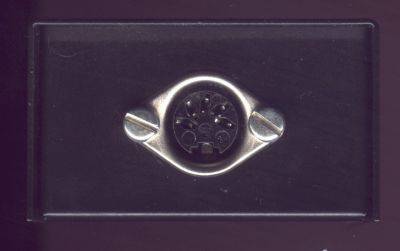 |
On the left hand side is the power outlet. It is the same type of socket as on the Acorn Type 2 clock. The Econet socket is on the right hand side of the box. There is only one socket so I wonder if this model was issued, or at least designed, before the introduction of the Type 2 Clock.
 |
The casing is made out of metal, painted black. Despite the metal, the Clock is very light. |
 |
The lid simply unclips from the base. There are no screws on this version. The top clicks into place when aligned with four bumps on the lower casing. In this picture, you can see some paint inside the lid which shows that the cases were assembled and then sprayed with black paint. I think they would have looked good if left with a silver metallic finish. |

Here we can see the clock circuitry. It is completely different from the Type 2 clock. It has only two integrated circuits, a Motorola 14411 and a 75159. There are three resistors and a capacitor on the circuit board as well as an L.E.D. There is space for five more resistors and two more capacitors and a diode.
Perhaps the most fascinating part of the insides of this American type Clock is the method of setting the clock speed. Instead of links for mark and space multiplier, as with the Acorn Clocks, or mark and period used in the SJ Research Clock, there is a single bank of links and one jumper which can be put in one of fourteen positions.
Here it looks like the data transfer rate is set rather than the speed itself. The fourteen link positions are marked 614K, 307K, 153K, 460K, 76K, 230K, 38K, 115K, 12K, 8613, 19K, 7035, 9600 and 4800. I do not know why they are in that order or why these values were chosen, although they do seem to equate to "baud rates" more commonly used with serial transfers.
Because there is no way of setting the mark and the space, I can only assume that this type of clock is a "symmetrical" clock, ie. with identical lengths of mark and space, like the Acorn Type 1 Clock.
 |
This is the clock connector to power and the LED is illuminated. Unfortunately, I bought the clock knowing it came without a power supply but it did not take me long to connect it up to a 9V DC power supply. Any similar power supply with the right end will do. |
 |
 | I think one of the most useful features missing from the more familiar U.K. Clocks is an indicator lamp to show the clock is working. This is implemented here but nobody seems have taken up the idea in Britain. |
I have tested this type of clock on my own Econet. I connected it to a spare socket of my main Econet and used Station 1 and Station 128 as a Level 2 file server with one of my 6502 Second Processors, using the free machine to try out various commands.
With speeds lower than 38K, nothing happened except a "Line jammed" error. They gave a "No clock" message on resetting the BBC Model B and caused the Master to wait, sometimes indefinitely. Setting the clock to the three lowest speed settings caused a different pitched noise to come out of the fileserver and seemed to slow the machine down considerably, as witnessed by holding down the "M" key to turn the Monitor on and off.
The network operated at 38K and all speeds up to 307K. This speed was just a little bit too fast for the network. Generally a catalogue command would work but the file server was very slow to respond and sometimes the output was jumbled. This speed also gave an occasional "Not listening" error on the Model B.
Speeds higher than 307K gave a "Net error" message although a valid clock signal was present. Eventually I might be able to test out this clock on a network involving an Archimedes to see if a higher speed can be achieved.
Overall, this is an extremely good clock. It is something of a curiosity, which increases its appeal to me, it is nicely made with the added feature of a power LED, and it works very reliably.
I am still searching for the Type 1 Clock but I am pleased to have been given a glimpse into American Econet history. The clock is part number 004. I know what part number 003 is (click here to find out!) and can only dream of what part numbers 001 and 002 might have been!!!!